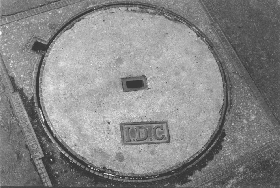
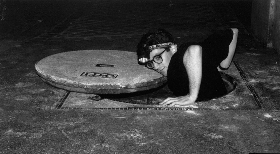
 Numerous entrances lead to the quarry networks.
Originally placed on street-level, on the side of a hill, or in open-air
quarries, these entrances were quickly transformed into service holes,
with or without ladder rungs and stairways.
There are dozens of entrances spread out below Paris.
For obvious security reasons as well as in accordance with the prefectorial
ban of November 2, 1955, most of these entrances have been condemned.
However a few of the entrances used by the police or the Inspector General
of the Quarries are still usable.
Generally covered by circular pieces of metal identical to those that
cover manholes, there are many different types of entrances:
straight and spiral staircases, holes with and without ladder rungs.
All the entrances were created for either the workers who exploited the
rock layers and extracts, or for the Inspector General of the Quarries'
employees, who have work to do in the quarries.
The multiplicity of air holes assures proper ventilation of the areas.
This ventilation, however, is what caused the cruel default of the Place Denfert ossuary, which was closed in January 1995 so that an aeration system could be installed: In order to keep away vandals and nighttime visitors, all potential entrances to the ossuary were carefully sealed.
In addition, there are dozens of stairways that serve the rest of the isolated quarries below Paris, which sometimes appear as caves and are the most often overlooked of the quarries.
During the 1980's, most cataphiles entered at the Boulevard Saint-Michel and from the Luxembourg neighborhood.


